Our cloth adventures continue. To further out cloth experiments, we created a curtain pulley system that simulated the grand, red curtains you often find in a theatre.
The first test was a sliding curtain. We assembled several attachment points, or pins, on the top of the cloth to simulate the movement of a curtain across a rod. The first pin was scripted to move up until it hits the next pin, then both pins move together until they hit the third pin, and so on. (↓)
Although there were no physical interactions, this prototype demonstrated the curtain’s foldability and realistic potential. There was some clipping, but it appears to be a persistent issue with these curtains or particle systems.
Now while the sliding mechanic does open the curtain, the next step is to incorporate the VR player into the scene so the player can pull open the curtains directly in front of the player. The player should be able to pull a rope down to open a curtain with a certain amount of force, and the curtain should fall closed if they release the rope. The rope should be fixed to the middle of the curtain and open in the fashion shown below. (↓)
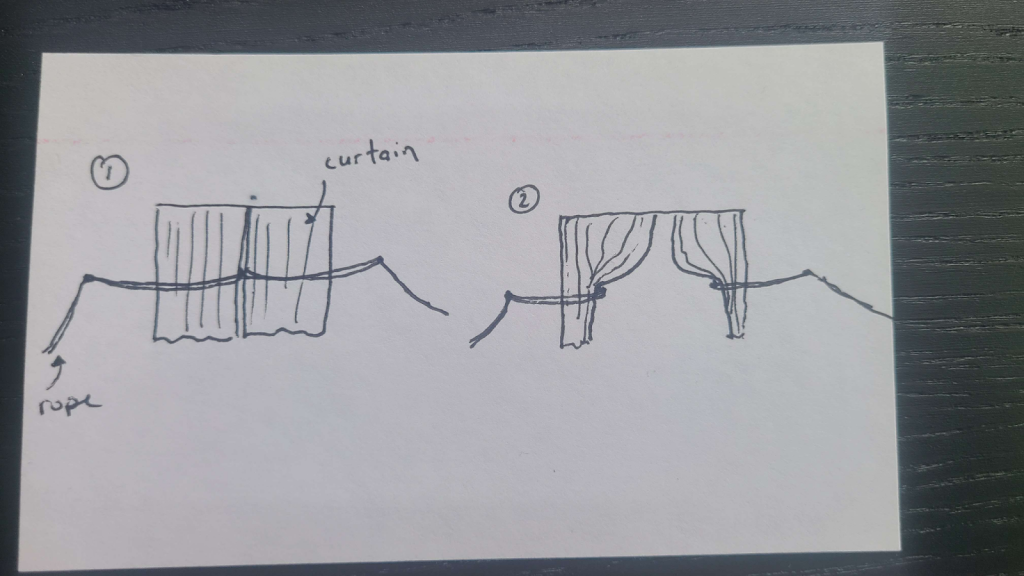
We decided to pivot to a curtain-pulley system, where a rope pulley configured from a rope package would pull the curtains outwards from the centre in a billowing effect in front of the player. We used a separate, player-controllable cube and pulley where its height proportionally opened and closed the curtains. (↓)
Why did we use a cube? We hadn’t looked into rope-grabbing yet, and the cube functioned as a stop gap.
One of the biggest issues was adding the rope to this system. A direct attachment between the rope and curtain made the interaction extremely stretchy, with the rope billowing upwards. We did get a bit ahead of ourselves combining these two soft-body physics systems before either of them were well understood. (↓)
To fix the issue, we added two bars for each curtain that swept the curtain open to replace the rope’s direct attachment to the curtain. The cube’s path of movement was determined by the box that we had created to control the pulley system. This was a physics-based interaction with some scripting. The left shows the prototype with the bar visible, and the right shows it with the bar hidden: (↓)
The hidden bar system did create our desired effect. We’d have to set up the scene to hide the incredible (and slightly overkill) pulley system though.
In order to make curtain-pulling a fully interactive feature, we will have to experiment more with rope physics. More to come!